

What is Moral Injury: When the Work You Care About Starts Violating Your Values
A doctor is running an understaffed ICU during COVID. There aren't enough ventilators. She has to decide, patient by patient, who gets one and who gets transitioned to comfort care instead. People are dying who might have lived with more equipment, more staff, more time. She made the call anyway, because someone had to.
A prosecutor is told by leadership to seek the maximum sentence on a minor, non-violent drug charge. Mandatory minimums leave him almost no discretion. He knows the sentence will gut the defendant's family, and he knows — because the data says so, over and over — that this law lands hardest on people who are already poor and Black or Brown. He argues the case anyway, because it's his job.
An engineer finds a safety defect in the software running an autonomous vehicle. She flags it. Leadership tells her to remove the finding from the risk assessment before the product launches. She's not the one who decided to ship it. She's just the one who knew.
None of these three did anything against policy. None of them, on paper, did anything wrong. And all three may carry the weight of these actions for years.
The Name For This Is Moral Injury
Moral injury is the lasting psychological distress that comes from perpetrating, failing to prevent, or witnessing an act that violates your own deeply held moral code. It's not about what happened to you. It's about what you did, or didn't do, or watched happen — measured against what you believe is right.
The term comes out of military psychology. Psychiatrist Jonathan Shay coined it working with Vietnam veterans, and the framing he used still holds: many people can recover from horror, fear, and grief once they're safely home — but not as easily when their own sense of "what's right" has been violated along the way. In the years since, clinicians have watched the same pattern show up far outside combat: in medicine, law, government, engineering, humanitarian work — anywhere a person's job can put them in a position where every available option costs something they believe in.
Recent recognition of moral injury as a legitimate condition warranting clinical attention is one sign this concept has moved past a niche, academic corner of psychology and into fields that increasingly need language for what their people are experiencing. Moral injury is not a diagnosis, but this recognition does confirm that this isn't a soft complaint or a personality problem — it's a real form of psychological harm, distinct enough to need its own name.
What It Actually Feels Like
The doctor doesn't describe fear when she talks about that ICU. She describes disgust — at the position she was put in, and sometimes at herself, for the choices she made under it. The prosecutor doesn't talk about danger. He talks about guilt that keeps him up at night, even though he followed the law exactly as written. The engineer isn't anxious about her physical safety. She's feeling a low hum of shame that she went along with the order at all.
Moral injury tends to show up as guilt, shame, anger, sorrow, disgust, and despair — often in some combination, often compounding over time as one bad situation stacks on another. People describe an inability to forgive themselves. Some pull back from relationships that matter to them, convinced they don't deserve the closeness. Some throw themselves into self-punishing behavior at work, as if success now would be some kind of theft.
Why This Isn’t Burnout, and It Isn’t Trauma
Burnout, trauma, and moral injury get used almost interchangeably in casual conversation, and that's a problem, because they call for different responses. The clearest way to tell them apart isn't the situation — it's the emotional note underneath it.
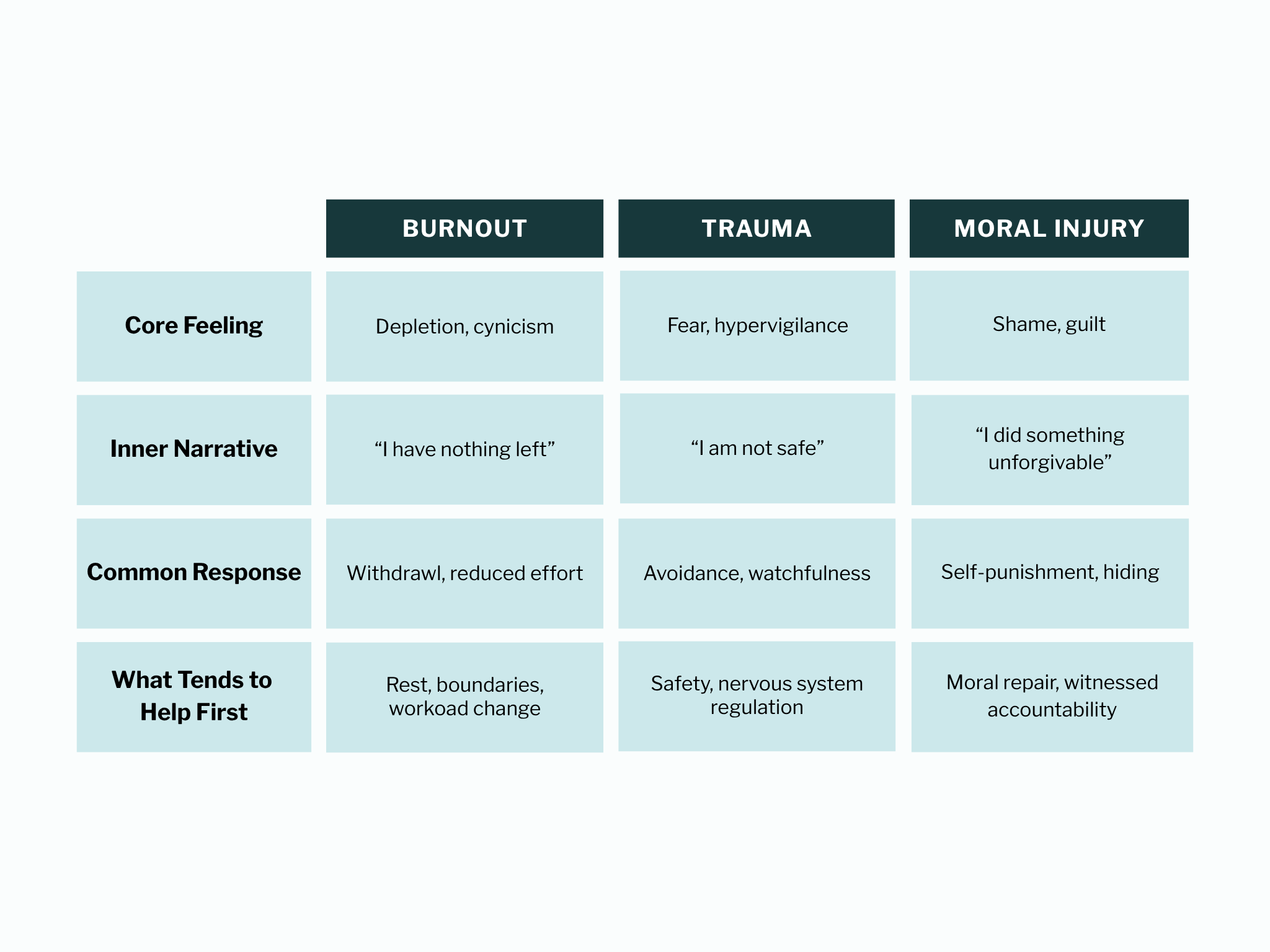
Burnout is what happens when the well runs dry — too much output, not enough replenishment, for too long. The fix starts with rest and a different workload, though it can run deeper than that if it's gone on long enough. Trauma is a nervous system that hasn't gotten the message it's safe yet. The body is still bracing.
Moral injury is neither. Rest doesn't touch it, because the person isn't depleted — they're convicted. Safety-focused interventions don't touch it either, because the danger was never physical. What's injured is the person's sense of themselves as someone who does the right thing. And because the dominant feeling is shame rather than fear or exhaustion, people with moral injury are more likely to hide than to ask for help. Fear says I'm scared, come find me. Shame says I don't deserve to be found.
This is also why moral injury is not, on its own, a diagnosis. It exists on a continuum, ranges widely in severity, and can occur alongside PTSD without being the same thing as it. Someone can be fully safe, fully regulated, and still experience moral injury.
In practice, the three often travel together. Someone doing sustained, high-stakes work is a good candidate for all three at once — depleted, on edge, and haunted by something they did or witnessed. The value of separating them isn't to force a clean diagnosis. It's to make sure the moral injury piece doesn't get missed and mislabeled as "just" burnout, which sends someone toward rest and time off when what they actually need is to experience being seen and not pushed away.
Who This Shows Up In
The doctor, the prosecutor, and the engineer above are composites, not case studies, but the situations are real ones we hear often. Moral injury tends to concentrate in work where the stakes are high, the choices are genuinely bad on all sides, and someone in a position of less power has to act anyway.
Given KonTerra Counseling's roots in the humanitarian and international development sector, this has been especially visible to us over the past couple of years. We've talked with humanitarian professionals inside the U.S. government who were tasked with saving lives while constrained by policy they had no power to change, in the face of the unfolding crisis in Gaza. We've talked with development and humanitarian workers who had to walk away from communities and local partners overseas — sometimes with days of notice — when foreign assistance funding was abruptly cut. We've talked with people who were evacuated from posts during the 2021 withdrawal from Afghanistan, unable to bring the national colleagues who'd worked alongside them to safety.
It shows up in immigration law, where an attorney can spend a career trying to do the least harm inside a system they didn't design and can't fix from the inside. It shows up in any profession where doing your job well and doing what feels right stops lining up — medicine, government service, journalism, the military-to-civilian transition, and plenty of workplaces that never make the news.
What Actually Helps
Reassurance doesn't help much here. Telling someone "you did the right thing" or "you had no choice" tends to bounce off, because the person isn't looking for permission — they're looking for a way to live with what happened. Willpower doesn't help either. And rest, while good for burnout, doesn't touch the underlying injury.
What helps is closer to repair than to recovery. That starts with sorting out actual responsibility from the much larger, harsher version the person has assigned themselves — most people carrying moral injury believe they had more control over the outcome than they did. It means making room for the full complexity of the moment: the time pressure, the incomplete information, the fact that every option in front of them cost something. And it means finding a way to act, even in a small way, in line with the values that got violated — because moral injury responds to moral repair, not just insight.
A recurring theme in the literature on healing from moral injury is the importance of bearing witness — someone willing to hear the full account, without flinching, without rushing to absolve, and without turning away. Scholar Rita Nakashima Brock, who has written extensively on moral injury and recovery, argues that this kind of healing rarely happens in isolation. It requires a witness. Shame, by its nature, thrives in secrecy — it loses power once it's spoken aloud to someone who can hold it without judgment.
This is, in practice, close to what therapy offers someone carrying moral injury: not absolution, and not a prescription for rest, but a steady, non-judgmental witness to the full story, and a structured way to work through it toward something more livable.
If This Sounds Familiar
If what you're carrying from your work feels less like exhaustion and more like something you can't forgive yourself for, that distinction matters — not because the label solves anything on its own, but because it points toward the kind of help that actually fits. Moral injury responds to a different approach than burnout or trauma, and naming it correctly is often the first real step.
If this description sounds familiar, therapy for moral injury might be worth exploring. Our clinicians each have direct experience working with professionals experiencing moral injury, and are available for telehealth sessions to clients in DC, VA, MD, TX and many places outside of the US. Scheduling a free consultation can be a good first step.

Why We Chose to Build
I remember exactly where I was sitting on January 24, 2025 when I read that all US foreign assistance would be paused.
I felt my entire body turn to ice. A rock settled in my stomach. I knew this was going to be bad.
In the weeks that followed, I watched USAID dismantled and lifesaving programs cruelly halted. I saw organizations go on life support overnight. I saw people, and their work, tossed aside.
At that time, every member of the KonTerra Counseling team was working closely with humanitarian and development professionals in various organizations. We were not immune to the trauma and the grief.
As we walked alongside colleagues and clients buffeted by uncertainty and unmoored from identity, we found ourselves asking the same question many of them were asking:
What do we do now?
We chose to build.
KonTerra Counseling’s clinicians – Donnica Wingett, Megan Williams, Camilla Tibbetts, Raven Ellis – had worked for The KonTerra Group, our sister company, at some point. As they were contemplating opening their own private practices, they approached The KonTerra Group ownership team and asked if there was a way to maintain their connection to KonTerra.
The KonTerra Group ownership team had considered opening a private practice at various points but the time had never seemed right. As we observed the devastation in the international humanitarian and development sector – and later the domestic public health, justice, scientific, education, and social service sectors – we knew the needs for quality mental health services delivered by clinicians who understood the complexity of high stakes work were great. Despite - or perhaps because of - the precarity of the moment, we founded KonTerra Counseling & Psychological Services.
This Isn't Only a Story About One Sector's Collapse
It's about what happens to anyone who gives a damn and is done being wrecked by systems that don't.
At KonTerra Counseling, our clients are often the people others rely on — the steady presence in crisis, the ones advocating, caregiving, leading. They're high-achieving, mission-driven professionals committed to making a difference in the world. Lawyers. Teachers. Healthcare workers. Government employees. Foreign Service Officers. Journalists. Aid workers. Or someone who just cares deeply about their work.
But behind the outward success and sense of purpose, there's often another story.
The Toll of Purpose-Driven Work
When your identity is tied to service, it's easy to ignore your own limits. You may delay rest because others need you. You may suppress your feelings to lead with strength. You may feel guilt for struggling when your work is "about" helping others.
This selflessness is admirable — and also unsustainable.
Over time, the internal cost adds up:
Emotional exhaustion and burnout
Disconnection from loved ones and from yourself
Difficulty being present or experiencing joy
A sense of isolation, even when surrounded by people
Shame for feeling like you're not coping "well enough"
Why This Is Our Focus
We choose to specialize in working with people like you because we understand the unique pressures you face — and the courage it takes to seek support. Every clinician on our team has experience working within large institutions. We understand the dynamics of toxic leadership, unrelenting demands, the pressure to compromise your ethics — not because we’ve read about them, but because we’ve lived them.
We don't just understand trauma and burnout; we understand the values that make you keep going — and how to help you find balance without letting go of what drives you.
Two KonTerras, One Purpose
For those of you who know us through The KonTerra Group's workplace-based programming with organizations in high-stress, high-stakes environments — we're still here, and still deeply committed to that work.
KonTerra Counseling & Psychological Services exists to extend that same commitment directly to individuals, not just the organizations they work for. Same values, same understanding of what this work costs a person — just a different door in.
If Any of That Sounds Familiar
If your professional world has shifted in ways you didn't anticipate, or your sense of purpose feels unsettled, you're in the right place.
The people we serve still believe in their work. What they're questioning is whether the systems around them will allow them to keep doing it.
That's the work. We're here for it.

Beyond Being Tired: The Anatomy of Burnout and Why Mental Toughness Can't Fix It
If you described this pattern to us in a first session, here's what we'd likely say back: you've been exhausted in a way that sleep and rest doesn’t help, for long enough that you can't remember the last time you felt rested. Work that used to deeply matter to you isn't getting you out of bed anymore. You're caring less, doing less, and starting to suspect you're not as good at your job as you used to be — maybe even resenting the people you're supposed to be helping.
That’s not a bad week. That’s burnout.
What Burnout Actually Looks Like
Burnout creeps up on you. It shows up in specific, recognizable moments: your first poor performance review in years, after a long stretch of strong work, because you simply don't have the energy left to care the way you used to. Crying in a bathroom stall or a stairwell between meetings. Being so depleted by Friday that your weekend — instead of being full of the people and things you love — dissolves into whatever requires the least cognitive or emotional effort, because that's genuinely all you have left to give. Decisions that used to be straightforward start to feel impossible. And underneath it, a whispered corrosive doubt: I'm trying to make a difference, and I'm no longer sure I actually am.
You may have first tried to think your way out of it.
I just need a vacation.
Or a better system.
Other people have it so much worse — I need to push through.
I've always handled hard things before; I should be able to handle this too.
But the effort to hold it together usually asks for more, not less. Work expands to fill more of your time, your thoughts, your emotional bandwidth, sometimes because it has to, sometimes because it's the one place that still feels within your control.
And it rarely stays contained to work. Partners, kids, friendships get the leftover version of you — the distracted, depleted one. For people used to performing at a high level in mission-driven work, this often comes wrapped in shame:
What's wrong with me that I can't handle this? Have I peaked? Am I ever going to be able to do this — the work, the promotion, the difference I wanted to make — again?
Maybe you’ve even found yourself wishing something would happen to you, just so you'd have permission to stop or escape.
Why “Push Through” Doesn’t Work
Burnout isn't evidence that you are broken. The World Health Organization officially recognizes burnout as an occupational phenomenon — a syndrome resulting from chronic workplace stress that hasn't been successfully managed, marked by exhaustion, growing mental distance or cynicism toward the job, and a reduced sense of professional effectiveness. It's a response to a system that isn't working. It is NOT a defect in the person inside it.
Christina Maslach’s research identifies six areas where a mismatch between a person and their workplace predicts burnout:
overwork
lack of control
insufficient reward
lack of community
unfairness,
values misalignment
That's why a vacation doesn't fix it. A new productivity system doesn't fix it. A new boss might help, but probably won't resolve it on its own. When the cause is structural, the fix has to address the structure — or at least a person's relationship to it.
What We Work On in Therapy for Burnout
This is where we begin in therapy, and where KonTerra Counseling's clinicians have deep experience. We don’t assume that you are broken. We suspect the system is.
So we typically work in a few directions at once:
Reclaiming choice and agency. One of burnout's most corrosive effects is the sense that you are trapped and there is no real choice available anywhere. We work on identifying where choice and agency actually exist and gradually expanding that terrain.
Real rest and recovery. Not just sleep, though sleep matters. Recovery from burnout means giving body, mind, and spirit genuine room to recover from the assaults they’ve absorbed — which looks different for different people.
Disentangling what's actually driving it. Burnout isn't one thing. For one person it's overwork. For another it's a deep sense of unfairness — a toxic environment, or bias and harassment tied to a marginalized identity. For someone else, it's a job that offers almost no control over how the work gets done. We work to identify which of these factors is doing the most damage for you, so the work targets what's actually depleting you rather than treating burnout as a single generic problem.
Making targeted, realistic changes. Burnout sits inside a larger system — an organization, sometimes a family system — that isn't within any one person's control to overhaul. So the work is about identifying realistic changes that can be made over time, not demanding a wholesale fix that isn't available.
Getting clear on values. Throughout all of this, we bring your own values into focus as a throughline — a foundation on which choices can be built, and the platform from which the future can start to look different and even hopeful.
One question comes up almost immediately: Am I going to have to leave my job? We don't start from that assumption. For many people, leaving isn't realistic given their responsibilities or the job market. More importantly, it's often not actually what they want. Our role is to help you find a way to keep doing meaningful work without it costing your health, your relationships, your sense of self, or your peace.
What Becomes Possible
Recovery from burnout doesn't mean the job or the workplace magically becomes easy. What we hope for — and what we see — is exhaustion giving way to real capacity for rest. Feeling trapped giving way to a sense of choice. Shame and self-blame loosening their grip. People setting real limits on how much space work takes up, and how much responsibility they carry by default. More presence in relationships, in hobbies, in the parts of life that matter outside of work.
And underneath all of it, more joy — not because everything got easier, but because people have more of themselves back: a stronger sense of who they are, what they value, and how they want to spend their time and energy.
If this description feels uncomfortably familiar, therapy for burnout might be worth exploring. Our clinicians - Donnica Wingett, Raven Ellis, Camilla Tibbetts, and Megan Williams — each have direct experience working with professionals experiencing burnout, and are available to clients in Washington DC and throughout Virginia, Maryland, and Texas.

When the New Job Doesn’t Fix What’s Broken: Support for Aid Workers Still Grieving
Being employed again does not mean you are okay again. For the humanitarian and international development professionals whose careers were upended over the past two years, "employed" and "okay" have turned out to be two very different things — and it’s important we talk about the difference.
"I just want my old job back!"
That's what someone we know blurted out at dinner recently, mid-conversation, without meaning to. They'd landed a new job months earlier. It's fine. They're doing work they care about — at least somewhat. But as the conversation wound through everything the last 18 months had cost them, that sentence arrived anyway: not composed, not planned, just true.
It's the kind of thing that slips out because the illusion of being fine takes real effort, and sometimes, mid-sentence, at a dinner table, the effort runs out.
You update your LinkedIn headline. You accept the offer letter. You tell everyone — your partner, your friends, your former colleagues still job-hunting, yourself — that you landed on your feet. And then, on a random Tuesday, someone mentions USAID in a meeting and something in your chest tightens like a fist. Or you're filling out an expense report for your new job in software sales and you remember filling out the same kind of paperwork for a program that kept girls in school somewhere you can't say out loud without your voice catching.
Being employed again does not mean you are okay again. For the humanitarian and international development professionals whose careers were upended over the past two years, "employed" and "okay" have turned out to be two very different things — and it’s important we talk about the difference.
The Job Search Ends. The Grief Doesn’t.
Most of the support available to laid-off aid workers has focused, understandably, on the job search itself: how to translate "led a $12M WASH portfolio across four countries" into language a hiring manager outside the sector will recognize, how to network, how to survive the silence after another application disappears into an applicant tracking system.
But almost nobody prepared you for what happens after you land the job.
No new role, no matter how good, is a time machine. It cannot take you back to a version of the world where your sector wasn't gutted, where your former colleagues still had their jobs, where the work you built your identity around still existed in the form you built it in. You can be grateful for stability and still be furious about what it cost to get there. Both things are true. Neither one cancels the other out.
Holding both at once - the gratitude and the furry - is exactly why KonTerra Counseling built a new support group: Employed But Seething & Grieving, a four-session series for current and former aid workers who've landed somewhere new and are definitely not okay.
Why Gratitude and Rage Can Coexist
If you're living in this in-between space right now, some of this will likely sound familiar:
You're relieved you can pay your bills again — and you still feel a low, steady unease that this, too, could be taken from you without warning. You've settled into the routine of a new role, but you're still searching for a way to live out the values that used to be built into your job description by default. You're surrounded by new colleagues who are perfectly kind and have no idea what the last two years actually cost you, so you keep the complexity of it to yourself.
And there's the sheer strangeness of the shift itself. You used to make sure a rural clinic had a reliable cold chain for vaccines. Now you're troubleshooting a CRM. The drop in scale — and in meaning — can feel almost disorienting, like you traded a language you were fluent in for one you're still sounding out.
None of this means you made the wrong choice by taking the job. It means the transition is more than a title change.
The Invisible Wound: Moral Injury
There's a term for part of what you might be carrying, and it's worth knowing because it's not the same as burnout: moral injury.
Burnout is what happens when the demands of a job exceed your capacity to meet them. Moral injury is different — it's the wound that forms when you're forced to act, or forced to stand by, in ways that violate your own values. Watching your sector dismantled while feeling powerless to stop it. Making an "impossible choice" — take the stable job or keep fighting for a mission that no longer has funding — and living with the residue of that choice long after it's made.
Moral injury doesn't heal the way ordinary stress does. It responds to being named, processed, and witnessed — not to a new job description.
Why A Job Search Support Group Isn’t What This Is
This distinction matters, because it shapes who this group is actually for.
This is not career transition support. If you're still actively job hunting, there are excellent resources built for exactly that — but this isn't one of them. It's also not individual therapy, and it's not designed for anyone currently in acute crisis, who deserves more intensive, individual support than a group format can offer.
This group exists for the space after the job search: for people who have already landed somewhere new and are discovering that landing wasn't the same as arriving.
What The Group Actually Offers
Over four sessions, the group creates room to do the work that a new job title can't do on its own:
Unburden the guilt of survival. Choosing stability wasn't a betrayal of your former colleagues or your former mission. It was an act of survival — and there's a real difference between the two that's worth learning to feel, not just know intellectually.
Grieve what was dismantled, out loud, with people who don't need the context explained to them first. The shock, the outrage, the loss of a community, and a future you'd built — all of it gets to take up space here.
Separate your worth from a sector that collapsed. Who you are was never only what organization your email signature belonged to. Untangling the two takes deliberate work.
Ease the sense of constant alert — the part of you still scanning for the next earthquake, still bracing for the ground to move again, even in a job that's objectively stable.
Redefine purpose and identity without pretending the loss didn't matter, and find a way to integrate the last two years into the story of who you're becoming, rather than getting stuck reliving them.
Who This Group Is For
You might be a strong fit if you:
Are a current or former international humanitarian or development professional whose work was disrupted by cuts to foreign assistance
Are back in the workforce, whether in a new sector or still in aid work
Feel a disconnect between your current job and the values that used to shape your work
Still carry real anger or grief you haven't had anywhere to put
Feel isolated from both old colleagues and new ones — surrounded by people, understood by few
Want a small, closed cohort of people who don't need the last two years explained to them
The Details
KonTerra Counseling's support group for current and former aid workers runs for four bi-weekly sessions, beginning Wednesday, September 16, from 7:00–8:15 PM ET, held online with a limited group size to protect the safety of the space. The cost is $297 for the full series, and payment plans are available for anyone facing financial constraints — because we believe access to this kind of support shouldn't depend on ability to pay.
As your facilitators, we (Donnica Wingett and Raven Ellis) have spent the last 18 months working directly with aid and development professionals navigating exactly this transition. We’re not approaching this from theory.
If the gap between "employed" and "okay" sounds familiar, you don't have to bridge it alone. Register here to join the next cohort.

When Doing Everything Right Still Isn't Enough: Support for Immigration Legal Professionals
I've sat with enough immigration attorneys, paralegals, and advocates to recognize the same story wearing different case numbers. You can't remember the last time you won a case. Not because you stopped fighting hard enough — because they keep changing the rules. You've spent your evenings learning to file habeas petitions you never expected to need, squeezed in between court appearances and the calls you still have to return. Law school never taught you how to tell a client something unbearable in a way that leaves them with any hope at all. You've had to learn that on the job, over and over, this past year more than most.
If you work in immigration law right now — as an attorney, a paralegal, a case worker, an advocate — you already know that "burned out" doesn't quite cover it.
A System Under Strain, Not Just a Heavy Caseload
Immigration legal work has always demanded stamina and moral clarity. That's not new. What's new is how much more of both it's demanding right now.
Policy shifts that used to happen occasionally now happen fast enough that yesterday's guidance can be obsolete by the time you walk into court. Caseloads that were already unsustainable have grown heavier. And underneath the paperwork and the deadlines, I watch you absorb something harder to name: the fear and trauma your clients carry, case after case, without much space to set any of it down.
Burnout is the word most people reach for. But burnout is what happens when a job's demands outpace a person's capacity to meet them — more hours, more cases, less recovery time. What a lot of immigration professionals are actually carrying goes further than that.
The Weight Under the Weight: Moral Distress and Moral Injury
There’s a difference between being exhausted by the work and being wounded when the realities of the work conflict with what you believe is right.
Moral distress is what you feel when you know the right thing to do but the system won't let you do it — when you can see exactly what your client needs and exactly why you can't provide it. Consider advising a client on whether to show up for a scheduled ICE check-in. Tell them to report, and they may be detained on the spot, possibly separated from their kids that same day. Tell them not to show, and you've counseled them to violate the terms of their case — and violated your own oath in the process. There is no version of that conversation where you walk away feeling like you did right by them. You did the least-wrong thing available, which is a very different feeling.
Moral injury goes a step further: it's the lasting harm that comes from having to act — or stand by — in ways that violate what you believe is right, over and over, until the residue of it doesn't wash off between cases. It's watching people in power actively dismantle due process, one policy memo at a time, while you do everything in your power to zealously advocate anyway, knowing the rules of the system keep getting rewritten.
Neither of these responds to a vacation. In my sessions, they respond to being named, processed, and witnessed by someone who understands the terrain — which is a very different kind of support than most burnout advice offers.
The Fear Isn't Only About Your Clients
For many people doing this work, the fear isn't only professional, and it isn't only about the people you represent.
A number of the immigration attorneys, paralegals, and advocates I work with come from mixed-status families themselves. You may be building a legal case for a client during the day and worrying about your own spouse, parent, or sibling's status the moment you close your laptop. The system you're fighting inside of isn't an abstraction you go home from — it's the same system that could reach into your own household.
And increasingly, the fear isn't only about your clients or your family. Immigration attorneys have themselves become targets — watched, questioned, in some cases investigated, simply for doing their jobs. Representing someone zealously used to be an unambiguous professional duty. For a growing number of the people I work with, it now carries a personal risk that didn't used to be part of the calculation.
This is what it looks like to do high-stakes work while afraid for yourself and the people you love — on top of everything else the job already asks of you.
This Isn't Therapy, and It Isn't a Coping-Skills Webinar
This isn't individual therapy — though for some people, that's also valuable and worth pursuing separately. It isn't a webinar full of generic stress-management tips that assume your job is comparable to any other demanding job. It's a small, confidential group of peers who are living inside the same system, facilitated by me — someone who has spent years working specifically with people in high-stakes, values-driven work, not learning the terrain alongside you.
What "Sustaining the Work" Actually Offers
I built this group, over six bi-weekly sessions, to make space for what the daily grind of the immigration legal system doesn’t allow:
Share the weight with people who don't need it explained. There's a particular relief in saying something out loud to a room that already understands why it's heavy, without having to translate it first.
Rebuild what used to work. Many of the coping strategies that carried you through earlier years of this work may have stopped being enough. Together, we find what actually holds up under the specific pressure you're facing now, not generic advice built for a calmer year.
Make room for the full emotional complexity of the work — the uncertainty, the advocacy fatigue, the moral distress — instead of compartmentalizing it until it demands attention on its own terms.
Reduce the isolation of carrying this alone. Community doesn't fix a broken system, but it changes what it feels like to work inside one.
Reconnect with why you started. Purpose doesn't disappear under pressure — it gets buried. Part of this work is finding it again.
Who This Group Is For
Based on the attorneys, paralegals, and advocates I've worked with, you're likely a strong fit if you:
Work full-time or pro bono in immigration law — as an attorney, paralegal, case worker, or advocate
Feel exhausted or burned out, more days than not
Can't fully shut work off, even when you're with the people you love
Notice the strategies that used to help you cope aren't working as well anymore
Carry the weight of impossible choices you've had to help clients make
Want to be with others who understand this specific work without a lengthy explanation
About Me
I'm Donnica Wingett, a bilingual Licensed Independent Clinical Social Worker with deep ties to both the humanitarian field and immigration work specifically. For the past six years, I've conducted mental health assessments for individuals navigating immigration proceedings, and I currently serve as an adjunct professor at Georgetown University Law School, helping law students develop a trauma-informed practice. I've also spent several years volunteering with Rainbow Railroad, supporting newly arrived LGBTQ+ refugees here in the DMV region.
I'm not approaching this work from the outside. I've spent years inside the same system you're navigating, working alongside people who do exactly what you do.
The Details
"Sustaining the Work" runs for six bi-weekly sessions — September 18, October 2, October 16, October 30, November 13, and December 4 — from 1:00–2:15 PM EST, held online with a limited, closed group size to protect the confidentiality of the space.
Pricing is tiered to reflect the realities of this field: $250 for nonprofit organization staff, $425 for those in for-profit firms, both discounted from standard rates. If cost is a barrier, reach out to discuss options — access to this kind of support shouldn't depend on your paycheck.
If you've been doing everything right and still feel like you're barely holding on, I want you to know you're not imagining it, and you don't have to carry it alone. Register here to join the next cohort.