

What is Moral Injury: When the Work You Care About Starts Violating Your Values
A doctor is running an understaffed ICU during COVID. There aren't enough ventilators. She has to decide, patient by patient, who gets one and who gets transitioned to comfort care instead. People are dying who might have lived with more equipment, more staff, more time. She made the call anyway, because someone had to.
A prosecutor is told by leadership to seek the maximum sentence on a minor, non-violent drug charge. Mandatory minimums leave him almost no discretion. He knows the sentence will gut the defendant's family, and he knows — because the data says so, over and over — that this law lands hardest on people who are already poor and Black or Brown. He argues the case anyway, because it's his job.
An engineer finds a safety defect in the software running an autonomous vehicle. She flags it. Leadership tells her to remove the finding from the risk assessment before the product launches. She's not the one who decided to ship it. She's just the one who knew.
None of these three did anything against policy. None of them, on paper, did anything wrong. And all three may carry the weight of these actions for years.
The Name For This Is Moral Injury
Moral injury is the lasting psychological distress that comes from perpetrating, failing to prevent, or witnessing an act that violates your own deeply held moral code. It's not about what happened to you. It's about what you did, or didn't do, or watched happen — measured against what you believe is right.
The term comes out of military psychology. Psychiatrist Jonathan Shay coined it working with Vietnam veterans, and the framing he used still holds: many people can recover from horror, fear, and grief once they're safely home — but not as easily when their own sense of "what's right" has been violated along the way. In the years since, clinicians have watched the same pattern show up far outside combat: in medicine, law, government, engineering, humanitarian work — anywhere a person's job can put them in a position where every available option costs something they believe in.
Recent recognition of moral injury as a legitimate condition warranting clinical attention is one sign this concept has moved past a niche, academic corner of psychology and into fields that increasingly need language for what their people are experiencing. Moral injury is not a diagnosis, but this recognition does confirm that this isn't a soft complaint or a personality problem — it's a real form of psychological harm, distinct enough to need its own name.
What It Actually Feels Like
The doctor doesn't describe fear when she talks about that ICU. She describes disgust — at the position she was put in, and sometimes at herself, for the choices she made under it. The prosecutor doesn't talk about danger. He talks about guilt that keeps him up at night, even though he followed the law exactly as written. The engineer isn't anxious about her physical safety. She's feeling a low hum of shame that she went along with the order at all.
Moral injury tends to show up as guilt, shame, anger, sorrow, disgust, and despair — often in some combination, often compounding over time as one bad situation stacks on another. People describe an inability to forgive themselves. Some pull back from relationships that matter to them, convinced they don't deserve the closeness. Some throw themselves into self-punishing behavior at work, as if success now would be some kind of theft.
Why This Isn’t Burnout, and It Isn’t Trauma
Burnout, trauma, and moral injury get used almost interchangeably in casual conversation, and that's a problem, because they call for different responses. The clearest way to tell them apart isn't the situation — it's the emotional note underneath it.
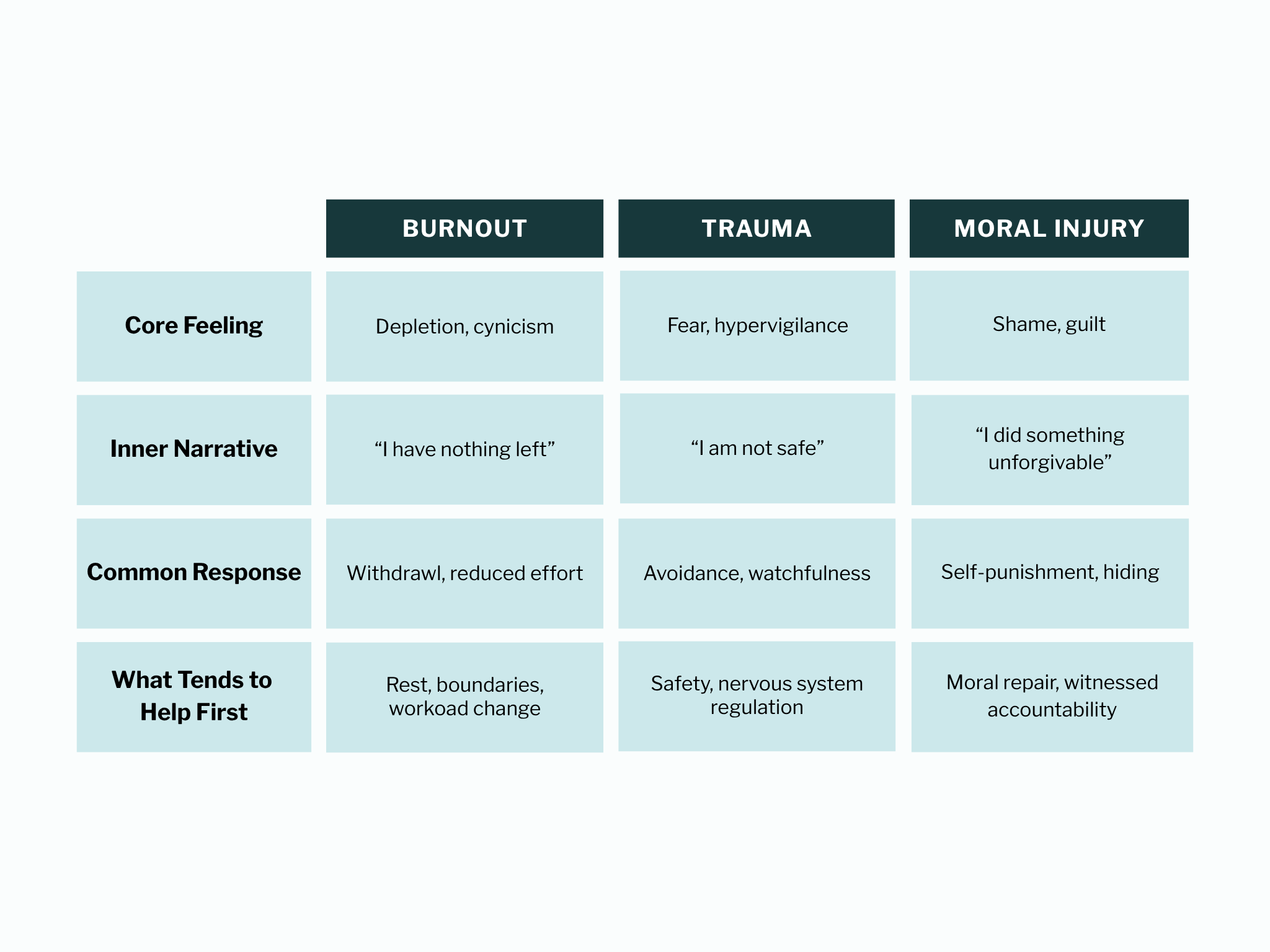
Burnout is what happens when the well runs dry — too much output, not enough replenishment, for too long. The fix starts with rest and a different workload, though it can run deeper than that if it's gone on long enough. Trauma is a nervous system that hasn't gotten the message it's safe yet. The body is still bracing.
Moral injury is neither. Rest doesn't touch it, because the person isn't depleted — they're convicted. Safety-focused interventions don't touch it either, because the danger was never physical. What's injured is the person's sense of themselves as someone who does the right thing. And because the dominant feeling is shame rather than fear or exhaustion, people with moral injury are more likely to hide than to ask for help. Fear says I'm scared, come find me. Shame says I don't deserve to be found.
This is also why moral injury is not, on its own, a diagnosis. It exists on a continuum, ranges widely in severity, and can occur alongside PTSD without being the same thing as it. Someone can be fully safe, fully regulated, and still experience moral injury.
In practice, the three often travel together. Someone doing sustained, high-stakes work is a good candidate for all three at once — depleted, on edge, and haunted by something they did or witnessed. The value of separating them isn't to force a clean diagnosis. It's to make sure the moral injury piece doesn't get missed and mislabeled as "just" burnout, which sends someone toward rest and time off when what they actually need is to experience being seen and not pushed away.
Who This Shows Up In
The doctor, the prosecutor, and the engineer above are composites, not case studies, but the situations are real ones we hear often. Moral injury tends to concentrate in work where the stakes are high, the choices are genuinely bad on all sides, and someone in a position of less power has to act anyway.
Given KonTerra Counseling's roots in the humanitarian and international development sector, this has been especially visible to us over the past couple of years. We've talked with humanitarian professionals inside the U.S. government who were tasked with saving lives while constrained by policy they had no power to change, in the face of the unfolding crisis in Gaza. We've talked with development and humanitarian workers who had to walk away from communities and local partners overseas — sometimes with days of notice — when foreign assistance funding was abruptly cut. We've talked with people who were evacuated from posts during the 2021 withdrawal from Afghanistan, unable to bring the national colleagues who'd worked alongside them to safety.
It shows up in immigration law, where an attorney can spend a career trying to do the least harm inside a system they didn't design and can't fix from the inside. It shows up in any profession where doing your job well and doing what feels right stops lining up — medicine, government service, journalism, the military-to-civilian transition, and plenty of workplaces that never make the news.
What Actually Helps
Reassurance doesn't help much here. Telling someone "you did the right thing" or "you had no choice" tends to bounce off, because the person isn't looking for permission — they're looking for a way to live with what happened. Willpower doesn't help either. And rest, while good for burnout, doesn't touch the underlying injury.
What helps is closer to repair than to recovery. That starts with sorting out actual responsibility from the much larger, harsher version the person has assigned themselves — most people carrying moral injury believe they had more control over the outcome than they did. It means making room for the full complexity of the moment: the time pressure, the incomplete information, the fact that every option in front of them cost something. And it means finding a way to act, even in a small way, in line with the values that got violated — because moral injury responds to moral repair, not just insight.
A recurring theme in the literature on healing from moral injury is the importance of bearing witness — someone willing to hear the full account, without flinching, without rushing to absolve, and without turning away. Scholar Rita Nakashima Brock, who has written extensively on moral injury and recovery, argues that this kind of healing rarely happens in isolation. It requires a witness. Shame, by its nature, thrives in secrecy — it loses power once it's spoken aloud to someone who can hold it without judgment.
This is, in practice, close to what therapy offers someone carrying moral injury: not absolution, and not a prescription for rest, but a steady, non-judgmental witness to the full story, and a structured way to work through it toward something more livable.
If This Sounds Familiar
If what you're carrying from your work feels less like exhaustion and more like something you can't forgive yourself for, that distinction matters — not because the label solves anything on its own, but because it points toward the kind of help that actually fits. Moral injury responds to a different approach than burnout or trauma, and naming it correctly is often the first real step.
If this description sounds familiar, therapy for moral injury might be worth exploring. Our clinicians each have direct experience working with professionals experiencing moral injury, and are available for telehealth sessions to clients in DC, VA, MD, TX and many places outside of the US. Scheduling a free consultation can be a good first step.